Care Guide
Monstera Species Guide: How to Identify the Most Popular Monsteras
Monsteras have become some of the most popular houseplants in the world, and it’s easy to understand why. Their dramatic leaves, fast growth, and tropical appearance make them a favorite among beginners and collectors alike. However, one thing that often confuses new plant owners is the number of different Monstera species and cultivars available.
Walk into a plant store or browse online, and you might see names like Monstera deliciosa, Thai Constellation, Albo, Adansonii, Monkey Mask, Esqueleto, Dubia, or Peru. Some of these are completely different species, while others are simply cultivated varieties of the same plant.
Learning the differences can help you choose the right plant for your home and avoid paying premium prices for plants that are being mislabeled.
What Is a Monstera?
Monsteras belong to a genus of tropical climbing plants native to Central and South America. In nature, they climb trees using aerial roots, eventually producing enormous leaves filled with dramatic holes and splits.
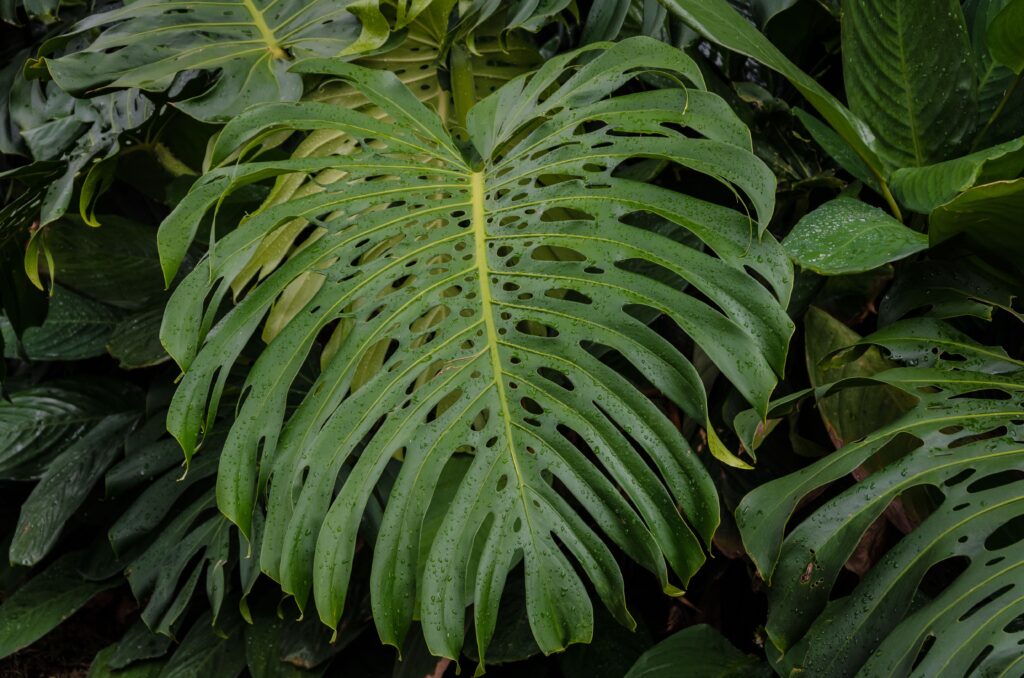
Those holes, known as fenestrations, are one of the defining characteristics of mature Monsteras. Scientists believe these openings may help the plant withstand heavy rain, allow light to reach lower leaves, or reduce wind damage, although several theories still exist.
Not every Monstera species develops the same type of fenestrations, which is one of the easiest ways to identify them.
Monstera Deliciosa
If someone simply says they own a Monstera, they’re usually talking about Monstera deliciosa.
This is the classic “Swiss cheese plant” seen in homes, offices, and social media posts around the world.
Young plants begin with solid, heart-shaped leaves. As the plant matures and receives plenty of light, support, and proper care, the leaves gradually develop deep splits that extend toward the center of the leaf. Mature specimens often develop additional interior holes between those splits, creating the iconic tropical appearance.
Indoors, Monstera deliciosa can eventually reach eight feet or more when given a moss pole or other climbing support. In tropical climates, they can become absolutely enormous.
One common misconception is that every deliciosa will immediately produce heavily split leaves. In reality, young plants often remain solid for quite some time before developing mature foliage.
Thai Constellation
One of the most recognizable Monsteras today is the Thai Constellation.
Many beginners believe this is a separate species, but it isn’t.
Thai Constellation is simply a variegated cultivar of Monstera deliciosa.
The cream-colored marbling was created through tissue culture and is genetically stable. Unlike some other variegated Monsteras, every Thai Constellation carries this pattern throughout the plant.
The amount of variegation varies from leaf to leaf, but the creamy speckles resemble stars scattered across the night sky, which inspired its name.
Because variegated portions contain less chlorophyll, Thai Constellations generally grow more slowly than standard green Monstera deliciosa. They also appreciate bright indirect light to support healthy growth.
If you compare a mature Thai Constellation to a mature green deliciosa, the overall leaf shape is almost identical. The primary difference is simply the beautiful cream variegation.
Monstera Albo
Another famous variegated Monstera is the Monstera Albo.
Like Thai Constellation, this is not its own species.
It is another variegated form of Monstera deliciosa.
The biggest difference is the variegation pattern.
Thai Constellation produces creamy speckles spread across the leaf.
Albo variegation often appears as dramatic white sectors, large splashes, or even completely white half-moon leaves.
Because Albo variegation is unstable, each new leaf is somewhat unpredictable. Some leaves may have only a little white while others may emerge almost completely variegated.
This unpredictability is part of what makes Albo Monsteras so desirable among collectors.
Monstera Adansonii
Monstera adansonii is often confused with Monstera deliciosa because both develop holes in their leaves.
However, they are very different species.
Adansonii produces much smaller leaves with numerous oval holes throughout the leaf blade.
Unlike deliciosa, the holes usually never reach the edge of the leaf. Instead, they remain enclosed within the leaf, creating a lace-like appearance.
The plant also tends to vine much more aggressively and produces thinner stems.
Given proper support, mature leaves can become surprisingly large, although they rarely resemble the broad leaves of deliciosa.
Is Monkey Mask Different?
This is probably one of the most common questions among plant buyers.
The answer is both yes and no.
In many garden centers, “Monkey Mask” is simply a marketing name used for Monstera adansonii.
However, the name has also been applied to several different forms of adansonii over the years, creating confusion among collectors.
Because of this, you should never assume “Monkey Mask” identifies a unique species.
If you’re shopping at a local nursery, chances are the Monkey Mask label simply refers to Monstera adansonii.
Monstera Esqueleto
At first glance, Monstera esqueleto can look similar to adansonii.
As the plant matures, though, the differences become obvious.
Esqueleto develops much larger leaves with dramatically oversized fenestrations.
Many of the holes become elongated and occupy a significant portion of the leaf surface, giving the foliage an almost skeletal appearance.
This unique look explains the name “Esqueleto,” which means skeleton in Spanish.
Collectors often seek this species because mature plants develop an appearance unlike almost any other Monstera.
Monstera Peru
Despite its name, Monstera Peru looks nothing like most Monsteras.
Its leaves are thick, glossy, and heavily textured.
Unlike deliciosa or adansonii, they develop almost no fenestrations.
Instead, the raised ridges across the leaf surface give the plant a rugged appearance.
Because the leaves are thicker and more rigid, many collectors appreciate Monstera Peru for its unusual texture rather than dramatic holes.
Monstera Dubia
Monstera dubia may be one of the strangest members of the genus.
As a juvenile, it barely resembles a Monstera at all.
Instead of hanging outward, the small leaves lie completely flat against a wooden board or tree trunk as the plant climbs upward.
The silver-green patterning makes juvenile plants especially attractive.
As the plant matures, the leaves transform dramatically into much larger foliage with entirely different characteristics.
This drastic change surprises many growers seeing an adult Dubia for the first time.
Why Do Monstera Leaves Develop Holes?
The famous holes, known as fenestrations, remain one of the most fascinating features of Monsteras.
Researchers continue studying exactly why they evolved, but several theories exist.
One suggests the openings help strong winds pass through the leaves instead of tearing them apart.
Another proposes that the holes allow sunlight to reach lower leaves growing beneath the canopy.
It’s also possible they improve water drainage during heavy tropical rainfall.
Whatever the exact reason, fenestrations have become one of the defining characteristics of the genus.
Choosing the Right Monstera
If you enjoy variegated plants, Thai Constellation offers stable cream marbling, while Albo provides unpredictable white patterns that make every new leaf unique.
If you prefer a more delicate, vine-like appearance, Monstera adansonii is an excellent choice and remains one of the easiest climbing Monsteras to grow indoors.
Collectors looking for something unusual may enjoy Monstera Esqueleto, Monstera Peru, or Monstera Dubia, each of which offers a completely different appearance from the classic deliciosa.
Whether you own one Monstera or an entire collection, understanding the differences between species makes shopping far less confusing and helps you appreciate just how diverse this remarkable group of tropical plants really is.